To choose veterinary equipment manufacturers, define the device and market first, then request evidence for regulatory status, quality controls, performance verification, traceability, service, and change management. Score each claim by the document that proves it. A logo wall or catalog breadth is not enough.
This guide is an evaluation framework, not a ranking. It is useful for clinics, hospital groups, distributors, and brands comparing a direct factory, a specialist diagnostic manufacturer, or an integrated veterinary equipment manufacturing partner.
How to Evaluate Veterinary Medical Equipment Manufacturers
Start by separating three roles. A legal manufacturer owns the device and its compliance responsibilities. A contract manufacturer builds to an agreed specification. A sourcing or integration partner may coordinate several specialist factories, logistics, training, and after-sales service. One company may perform more than one role, but the contract should name who owns each obligation.
Next, write a one-page sourcing brief. State the users, animal species, sample or imaging workflow, environment, daily volume, languages, target countries, installation needs, and service model. A buyer planning a pet hospital design and build project needs a different supplier structure from a distributor launching one analyzer.
| Evaluation gate | What to ask | Evidence to review | Red flag |
|---|---|---|---|
| Identity and scope | Who is the legal manufacturer for this exact model? | Company identity, model list, manufacturing address, role statement | Documents refer to another company or an unspecified product family |
| Market readiness | What must be completed before sale in our target country? | Applicable registrations, conformity documents, labeling plan, local representative details | “CE/FDA available” without model, scope, issuer, or current status |
| Clinical and technical fit | How is performance verified in our intended workflow? | Specifications, test method, sample report, acceptance criteria, validation summary | Only marketing claims or a live demo with no acceptance protocol |
| Production control | How are incoming parts, assembly, release, and changes controlled? | Inspection records, batch or serial traceability, release checklist, change-notice process | No lot history, no revision control, or silent component substitution |
| Lifecycle support | Who trains users, supplies consumables, handles faults, and issues updates? | Training plan, spare-parts list, service levels, escalation path, warranty terms | Support promises are absent from the commercial agreement |
Key Credentials: Verify Scope, Not Just the Logo
Credentials are useful only when they match the product, site, process, and destination market. Ask for the full document, its issuing body, expiry or validity status, covered address, covered activities, and product scope. Verify it with the issuer or regulator when a public database is available.
Market rules also differ. The UK Medicines and Healthcare products Regulatory Agency guidance distinguishes registration, conformity marking, manufacturer location, and responsible-person duties. The European Commission medical-device regulations overview provides the official EU regulatory context. Confirm whether your veterinary product is regulated as a medical device, an IVD, electrical equipment, or another product category in the destination country; do not assume that human-medical and veterinary rules are identical.
Credential request package
- Legal entity name and manufacturing-site address.
- Quality-management certificate with scope and validity details, where applicable.
- Model-specific declarations, registrations, test reports, and labeling evidence required for the target market.
- Electrical safety, electromagnetic compatibility, software, cybersecurity, biocompatibility, or metrology evidence when relevant to the device.
- Complaint, corrective-action, recall, and field-action procedures.
Vetsplex publishes its evaluation approach through its veterinary equipment quality system. Buyers should still request the current, model-specific evidence package for their project rather than relying on a general quality page.
Quality Metrics That Predict Delivery and Field Performance
A useful metric has a definition, sampling rule, time window, owner, and source record. “High quality” has none of these. Replace it with measures that can be checked during qualification and repeated after production begins.
| Metric | Define it before comparing | Why it matters |
|---|---|---|
| Incoming acceptance | Critical parts, sample plan, failed-lot handling | Shows whether supplier variation is detected before assembly |
| First-pass yield | Process step, rework treatment, product revision | Exposes hidden rework and process instability |
| Final release pass rate | Release test, acceptance limits, sample versus full inspection | Connects shipment approval to agreed specifications |
| Complaint rate | Units or tests in service, complaint categories, reporting window | Measures field experience, not only factory output |
| Corrective-action closure | Severity, root-cause method, effectiveness check, overdue rule | Shows whether recurring faults are actually controlled |
| On-time, in-full delivery | Confirmed date, partial shipment rule, buyer-caused exclusions | Measures supply reliability with a shared definition |
Add traceability questions: Can the supplier connect a finished serial or batch to critical components, inspection results, software version, and release record? Can it identify affected shipments after a change? This matters whether you source veterinary medical equipment in bulk or a small pilot run.
Transfer Clinical Requirements Before Comparing Catalogs
Supplier selection fails when buyers compare brochures before they define the job. Translate clinical needs into measurable inputs and acceptance tests. For diagnostics, map sample type, preparation, throughput, result format, quality control, consumables, and operator training. Use the same logic for imaging, surgery, dental, and routine practice equipment.
Diagnostic and laboratory workflows
For a veterinary laboratory equipment project, first define the test menu. Separate veterinary blood analysis and broader animal blood analyzer workflows from microscopy-led applications.
Then document whether the platform must support veterinary fecal analysis or urine sediment examination. Define report fields, operator steps, sample handling, cleaning, controls and acceptable downtime for the complete in-clinic veterinary testing workflow.
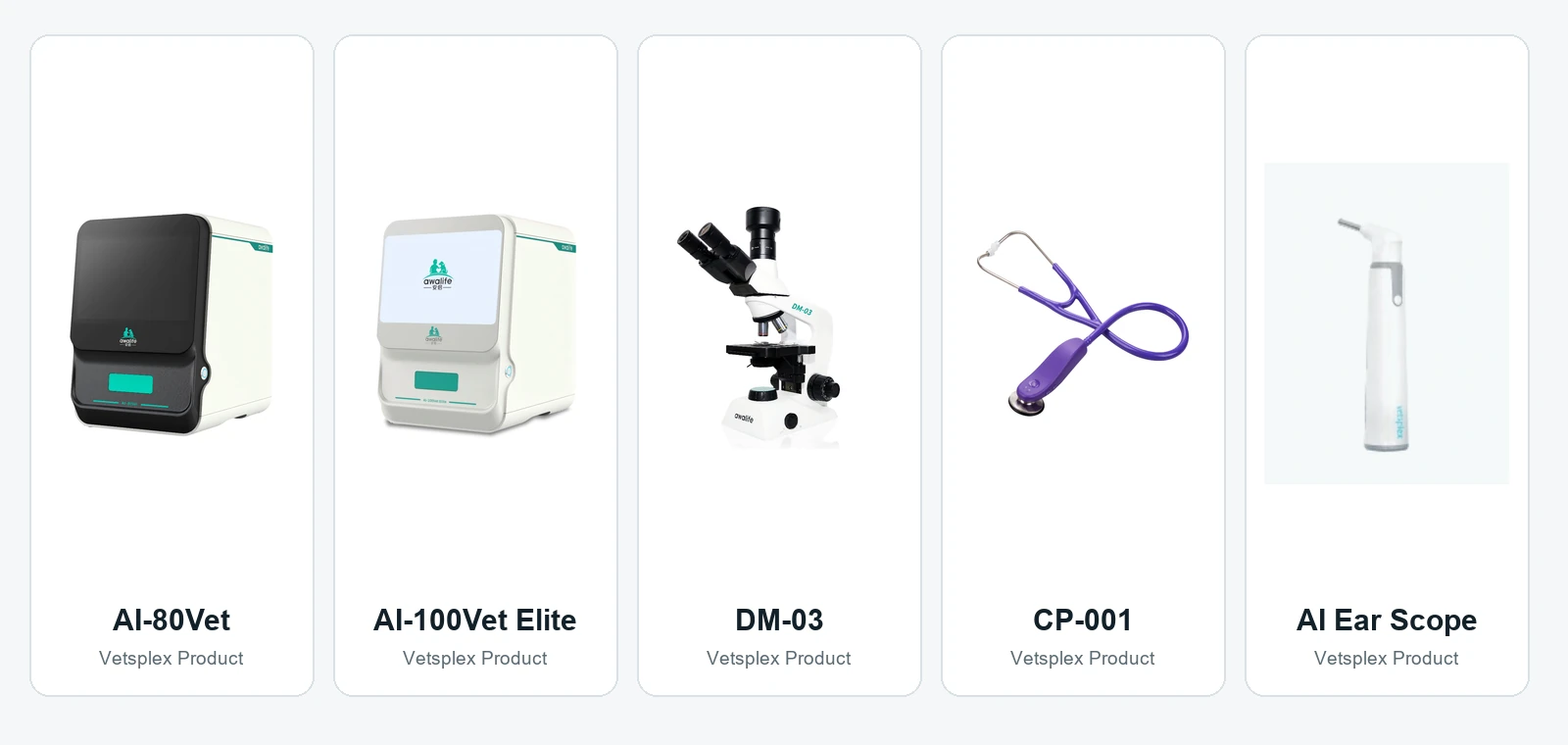
Ask the manufacturer to demonstrate the agreed workflow on the exact configuration you intend to buy. Vetsplex offers the AI-80Vet veterinary analyzer and AI-100Vet Elite as reference products for discussing morphology-based diagnostic requirements. Their product pages describe their known use scope; final procurement criteria should remain project-specific.
Microscopy and imaging workflows
A microscopy brief should cover optics, camera output, PC connectivity, annotation, image capture, reporting, calibration, and file management. The DM-03 veterinary digital microscope provides a traceable Vetsplex example, while the veterinary microscope buying guide helps turn those workflow needs into selection criteria.
Hospital buyers should also separate imaging from treatment-room infrastructure. A veterinary dental suite, everyday veterinary practice supplies, and a stethoscope for vets have different evidence, replenishment, installation, and service needs. A single catalog is not proof that one factory controls every category.
OEM/ODM Requirements Change Who Owns the Risk
OEM and ODM are not just branding choices. They change responsibility for product requirements, design records, verification, software, labeling, market access, production changes, complaints, and field actions. Put those responsibilities into a written matrix before discussing price.
A veterinary IVD OEM/ODM manufacturing project needs tighter control of analyte or morphology claims, sample workflow, consumables, software outputs, and verification than a cosmetic private-label project. A veterinary analyzer custom manufacturing brief should also state which party owns the product specification, change approvals, source code or firmware access, tooling, technical files, and post-market support.
Distributors should connect manufacturing terms to channel obligations. Confirm wholesale packaging and replenishment for veterinary medical supplies wholesale, then define territory, training, escalation, and launch support for veterinary equipment distribution cooperation. Compare that structure with the services expected from veterinary medical supply companies rather than judging every candidate as if it were a direct factory.
Vetsplex Manufacturing Profile: What Is Known
Vetsplex is positioned as an independent, one-stop veterinary medical equipment integration partner. Its documented profile covers diagnostics, digital microscopy, imaging, hospital equipment, distribution, and OEM/ODM coordination. The model is a multi-factory supply-chain platform, not a claim that every category comes from one production line.
The practical advantage is requirement routing. A buyer can begin with the operating needs of veterinary clinics or animal hospitals, then match each category to a suitable specialist supply path. Broader animal medical equipment procurement may require several qualified sources rather than one nominal manufacturer.
For a mixed diagnostic suite, review imaging, laboratory and recurring-supply responsibilities separately. Vetsplex documents coverage for veterinary imaging equipment, veterinary haematology analysers, and a wider veterinary medical products catalog.
This profile should be treated as the start of due diligence. For each project, request the actual legal-manufacturer identity, model-specific documents, test and release criteria, production location, change-control route, warranty, training, and service commitments. The Vetsplex role and the factory role should be clear in the proposal and contract.
Build a Defensible Manufacturer Shortlist
- Freeze the brief. State intended use, users, workflows, target market, volumes, languages, installation, training, and support.
- Apply pass/fail gates. Remove candidates that cannot prove identity, scope, market readiness, or basic traceability.
- Score evidence, not promises. Give more weight to current model-specific records than presentations or generalized certificates.
- Run a technical review. Compare samples or demonstrations against a prewritten acceptance protocol.
- Audit the risk path. Inspect critical suppliers, change control, nonconformance handling, release, complaints, and service escalation.
- Pilot before scale. Use a controlled first order with defined acceptance, field feedback, and corrective-action terms.
- Contract the lifecycle. Cover documentation, changes, spare parts, consumables, training, software, warranty, recalls, and exit rights.
Procurement teams can use this sequence for one device or for a multi-category sourcing program. It also prevents a common mistake: choosing a low unit price before calculating validation work, installation, consumables, downtime, service, and regulatory rework.
Frequently Asked Questions
Should I use a veterinary equipment manufacturers list?
A list can create a research pool, but it should not decide the purchase. Shortlist candidates only after checking the exact product scope, legal-manufacturer role, target-market evidence, quality controls, service, and change management.
Does a quality certificate prove that a veterinary device is approved?
No. A quality-system certificate and a product's market authorization or conformity evidence are different. Verify the certificate scope and then review the model-specific documents required in the destination market.
What should I ask an OEM manufacturer before requesting a quote?
Send the intended use, target markets, product requirements, acceptance tests, forecast, customization scope, labeling needs, service model, and ownership matrix. A quote without those inputs is difficult to compare.
How can a distributor reduce supplier risk?
Use pass/fail qualification gates, verify model-specific evidence, pilot the product, define change notifications, hold clear spare-parts and training commitments, and track field complaints by model and batch or serial number.
Turn Your Requirement Brief into a Manufacturer Review
Share the product category, intended workflow, destination market, forecast, customization level, and service needs. Vetsplex can help map the request to a diagnostic, microscopy, imaging, hospital-equipment, wholesale, or OEM/ODM supply path—and identify the evidence still needed before a commercial decision.